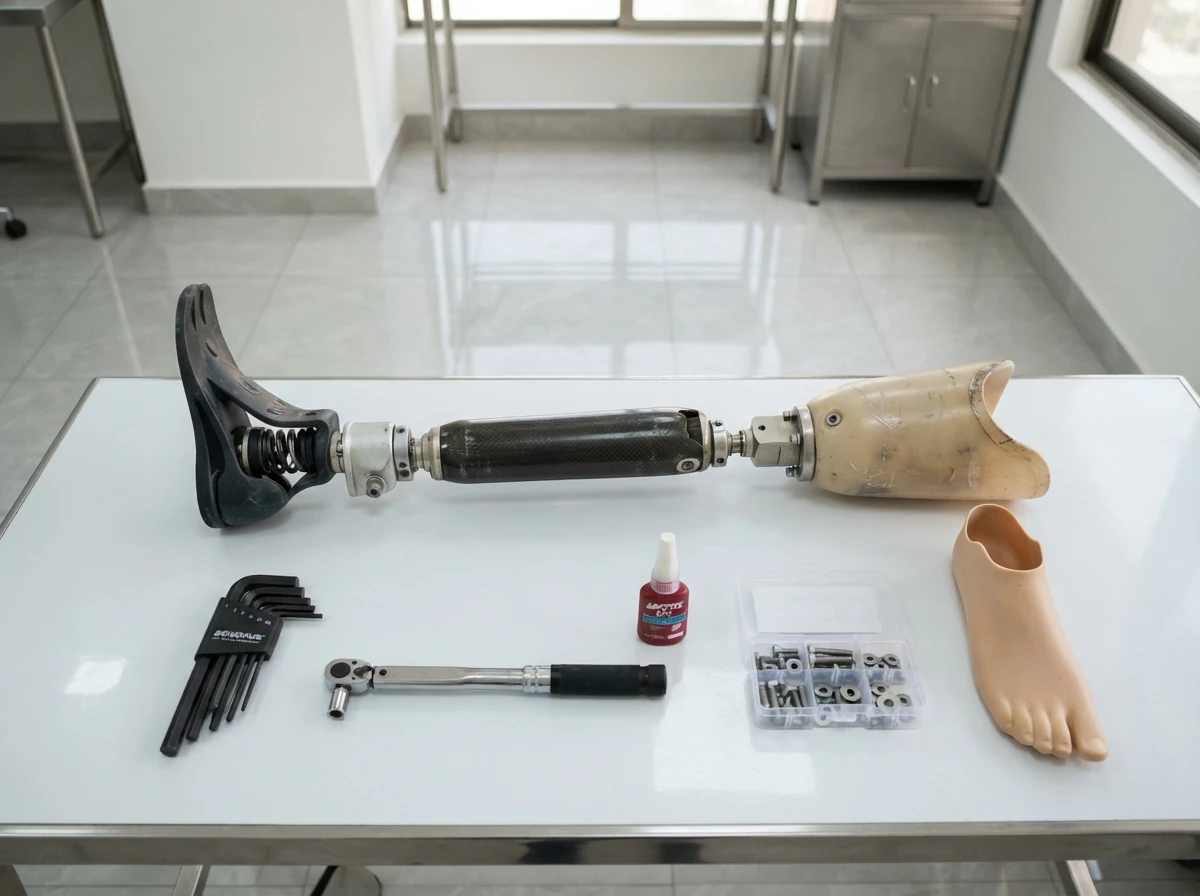
Artificial leg repair and maintenance
A leg that takes five thousand steps a day in dust, heat and humidity is a hard working machine. Small faults announce themselves with a click or a wobble long before anything breaks. Most repairs are quick and inexpensive if they are caught early.
How do you maintain an artificial leg?
Wipe the socket and wash the liner every night. Check the leg weekly for cracks, loose bolts, and wear to the foot shell and straps. Keep it dry. Have it professionally serviced once a year, when bolts are re-torqued, moving parts are cleaned and worn bushes are replaced. Any new noise, wobble or change in how it feels should be checked promptly.
Daily, weekly and yearly
Every night
Wipe the inside of the socket with a damp cloth and let it dry. Wash the liner or socks. Look over your skin. Stand the leg upright in a dry place, away from the bathroom.
Every week
Look for cracks in the socket edge, tears in the liner, a loose or torn foot shell, frayed straps, and any play when you rock the foot or knee by hand.
Every year
A workshop service: bolts checked to the correct torque, knee and ankle parts cleaned, bushes and bumpers replaced, alignment and leg length reviewed.
What that noise or feeling usually means
| What you notice | Likely cause | What to do |
|---|---|---|
| Clicking with each step | A loose adapter screw, or a worn foot bolt | Stop long walks. Come in within a day or two. It is a five minute fix now, a fall later. |
| The leg feels looser than last month | Stump has shrunk, or liner has thinned | Add a sock. If you are at ten ply, book a socket review. |
| Squeaking from the foot | Foot shell rubbing the keel, or water inside | Dry it. A little talc inside the shell helps. If it persists, have it opened. |
| Knee wobbles side to side | Worn knee bushes | Book a service soon. Do not ignore it. |
| Pin lock will not release, or will not click in | Dirt in the lock, bent pin, or sock caught on the pin | Do not force it. Call us. We can often talk you through it. |
| A crack in the socket | Fatigue or impact | Stop wearing the leg. A cracked socket can fail without warning. |
| The leg suddenly feels longer or shorter, or turns in | An adapter has slipped | Do not walk on it. Call us. |
| A bad smell from the liner | Bacteria from sweat | Wash nightly with mild soap and dry fully. Replace liners that are past their life. |
What to do if the leg fails
Call or WhatsApp us at any hour. Tell us what happened and send a photo. We will tell you whether it is safe to walk on, and book the earliest workshop time.
- Do not walk on a leg that has slipped, cracked or gone loose. Use crutches or a wheelchair until it is seen.
- Do not use glue, tape or wire on a structural part. It hides the damage and makes the proper repair harder.
- Do not tighten the alignment screws yourself. Tightening one tilts the leg. If a screw has fallen out, bring it with you.
- Keep your old leg. A worn but safe old leg is a valuable spare while the main one is repaired.
- Keep crutches in the house. Every prosthesis user should own a pair, for repairs, for sore skin days and for the night.
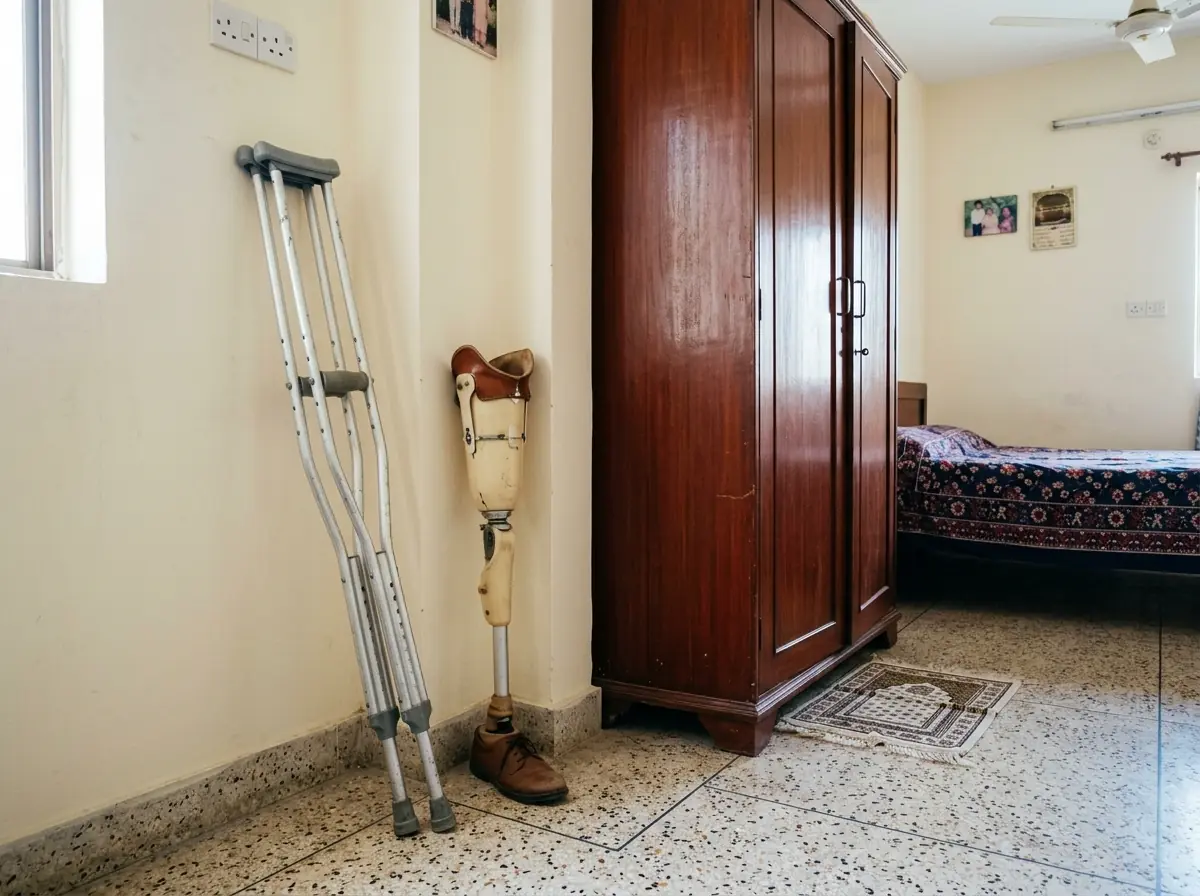
Legs made at another clinic, in another city, or abroad
We repair and service legs that were not made by us. People move cities, clinics close, and relatives send legs from abroad. Nobody should be left without support.
We begin with an inspection and tell you plainly what we find: what is worn, what is safe, and what we would not put our name to. Where a part is proprietary and cannot be sourced here, we will say so and suggest an equivalent.
If the socket no longer fits but the parts are sound, a new socket on your existing parts is often the most economical route. If the parts are unsafe, we will show you why before suggesting any replacement.
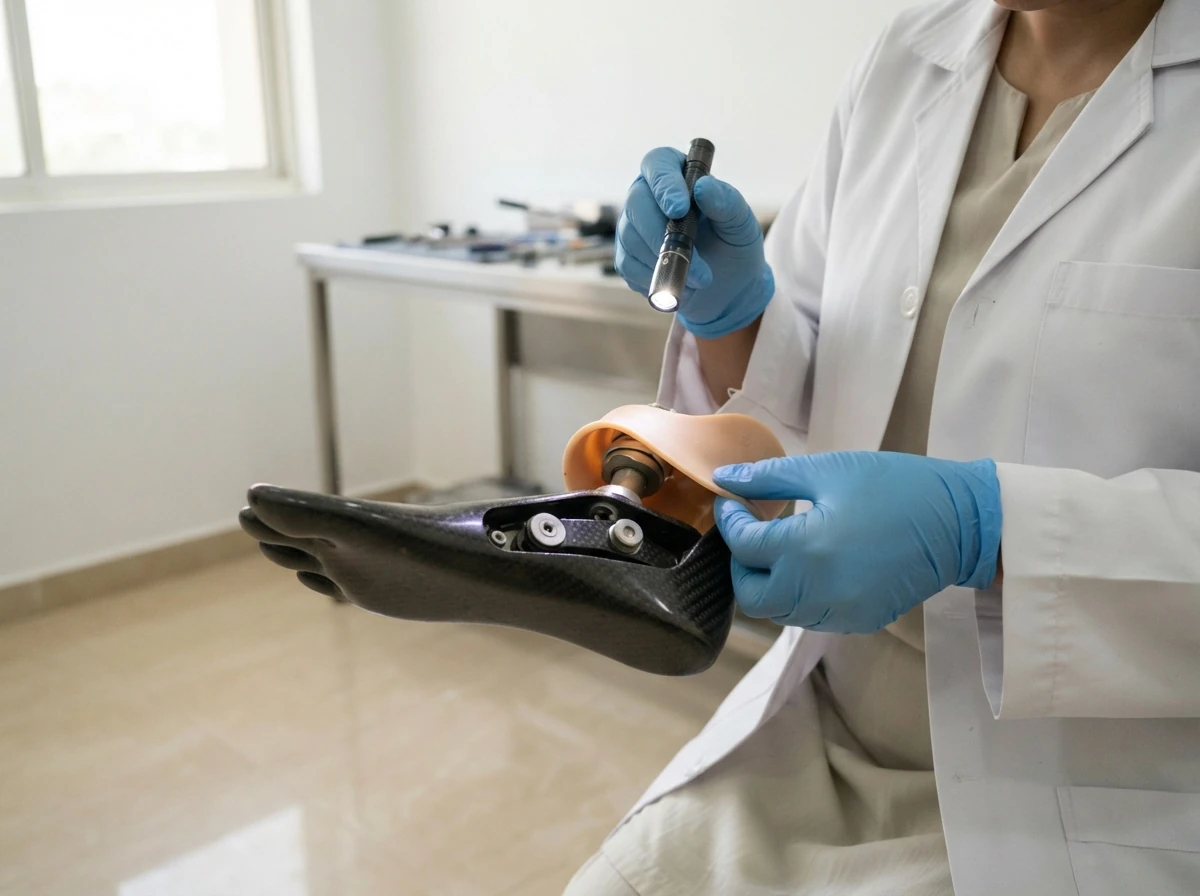
Three local enemies of an artificial leg
Humidity and water
Sea air and monsoon damp corrode steel bolts and seize locks. Keep the leg out of the bathroom and wipe it after rain.
Dust and sand
Fine grit works into knee and ankle joints and grinds the bushes. A knee cover helps. Do not oil joints, because oil holds grit.
Heat
A leg left in a parked car or on a sunny windowsill can soften a plastic socket and spoil a liner. Store it in the shade.
Repair and service prices in Karachi
| Work | Indicative range (PKR) |
|---|---|
| Inspection and written report | Free with any repair |
| Annual service, below knee leg | 3,000 to 8,000 |
| Annual service, above knee leg with mechanical knee | 6,000 to 18,000 |
| Re-torque and minor adjustment | 1,500 to 4,000 |
| Replacement foot shell | 6,000 to 25,000 |
| Replacement pin lock or valve | 8,000 to 35,000 |
| New straps, belt or sleeve | 3,000 to 15,000 |
| Socket padding or relining | 4,000 to 15,000 |
| Knee bushes and bumpers | 5,000 to 25,000 |
| New cosmetic cover | 12,000 to 40,000 |
Parts for imported knees and feet are quoted individually, as they depend on the maker and the exchange rate.
How quickly can a repair be done?
Tightening, adjustments and many part swaps are done while you wait. Work that needs lamination, or a part to be ordered, takes longer, and we give you a date. Tell us if you have no spare leg so we can prioritise.
Do you repair legs made by other clinics?
Yes, after an inspection. We tell you what is safe, what is worn, and what we recommend, before any work is done.
Can I oil a squeaky knee?
Please do not. Household oil attracts dust and turns it into grinding paste, and can damage seals in hydraulic units. Bring it in. It usually needs cleaning and new bushes.
How do I clean the socket and liner?
Wipe the socket with a damp cloth and a little mild soap, then a clean damp cloth, and let it air dry. Wash the liner by hand in lukewarm water with mild soap, rinse very well, and dry it on its stand away from the sun.
How long should a leg last?
With yearly servicing, the structure commonly lasts three to five years. Liners last six to twelve months, foot shells one to two years, and the socket until your stump changes.
Leg making a new noise?
Send a short video on WhatsApp or call at any hour. We will tell you if it is safe to walk on and book the earliest repair time.
- Answered on WhatsApp, 24/7
- First assessment free, no obligation
- Nothing is stored on this website