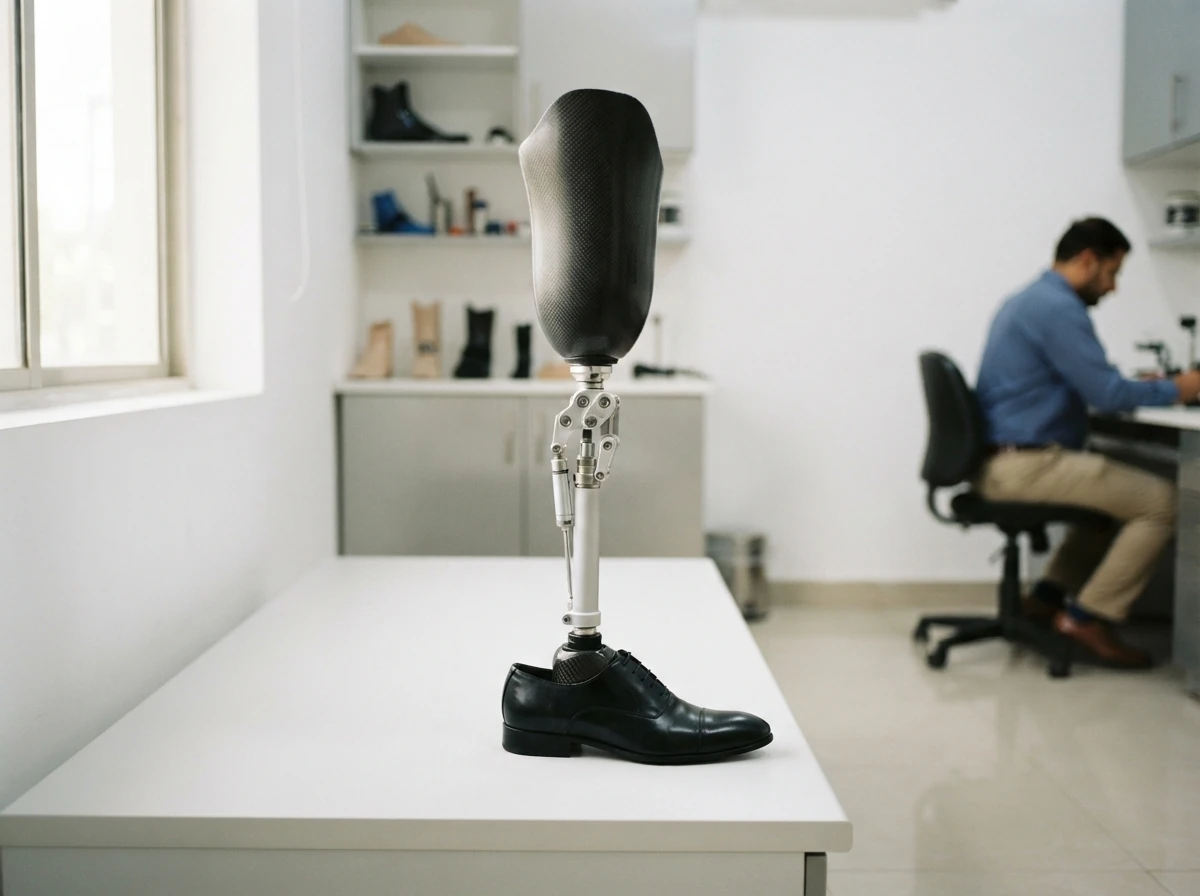
Above knee artificial leg in Karachi
Above the knee, the artificial leg has to do the work of a knee as well as a shin and foot. The right knee joint for your strength and age, inside a socket you can sit and walk in, decides whether you trust the leg.
What is an above knee artificial leg?
It is a prosthesis for an amputation through the thigh, also called a transfemoral prosthesis. It has a socket that holds the thigh and takes weight near the sitting bone, an artificial knee joint, a pylon and a foot. Walking takes much more effort than with a below knee leg, so the knee is chosen mainly to keep you from falling.
A thigh socket has two jobs: carry weight and steer the leg
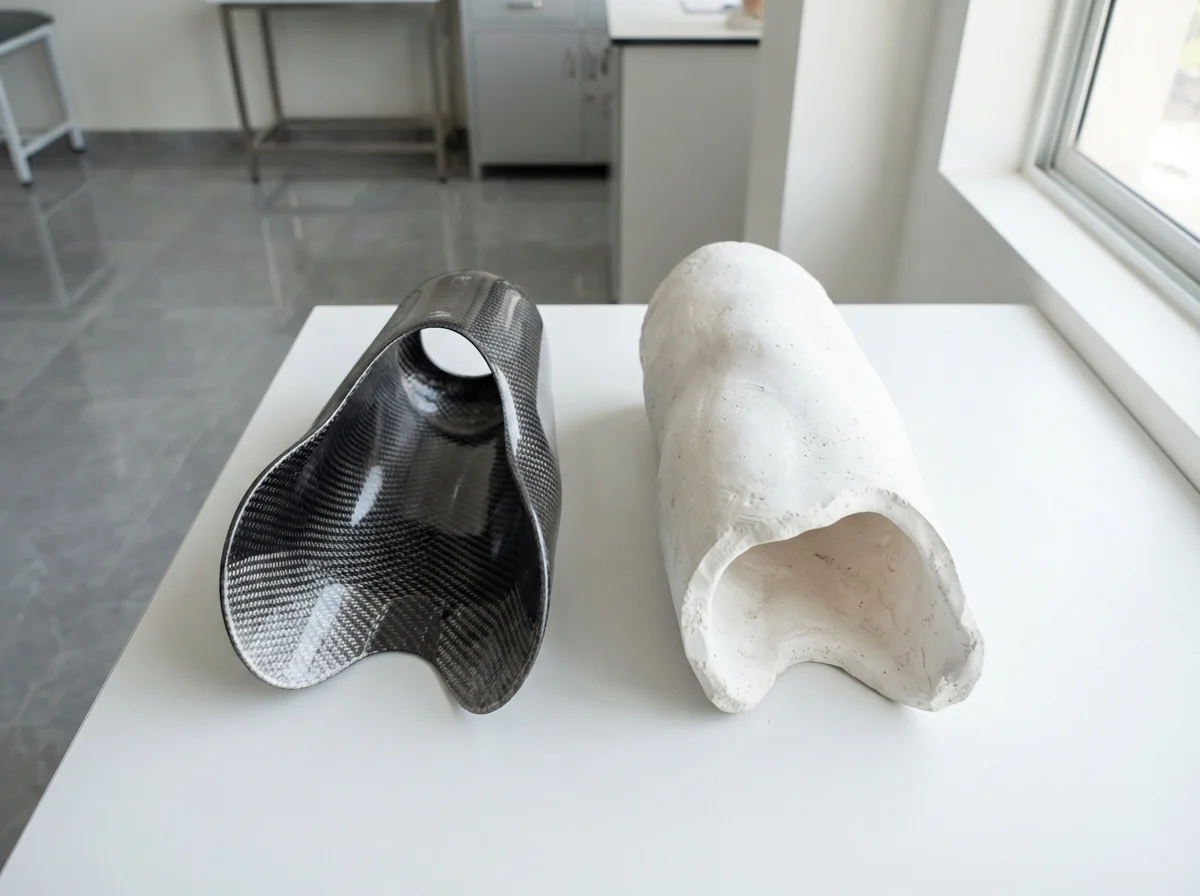
There is no bone end strong enough to stand on in the thigh, so the socket carries your weight higher up, around the sitting bone and the soft tissue of the thigh. Two shapes are used.
Quadrilateral socket
A four sided shape with a flat shelf for the sitting bone. Simple to make and adjust. It can let the thigh bone drift outward, which makes some users lean to the side.
Ischial containment socket
A narrower shape that cups the sitting bone inside the socket. It holds the thigh bone straighter and gives better control, especially on short stumps. It takes more skill and more fitting time.
Most discomfort is felt at the top inner edge, in the groin. That edge is where we spend the most adjustment time, because a socket you cannot sit in will not be worn.
Knee joints, arranged by how much they protect you
A knee that bends when you do not expect it causes a fall. Pick safety for your situation first. Speed and looks come after.
| Knee type | How it behaves | Usually suits |
|---|---|---|
| Manual lock | Stays straight while walking. You release a lever to sit. | Frail or elderly users, very short stumps, first legs where fear of falling is high |
| Weight activated safety knee | Brakes itself when weight is on it, swings freely when unloaded | Older and moderate walkers on flat ground |
| Four bar polycentric | Its geometry makes it stable at heel strike and it folds compactly | Most adults. A good balance of safety, price and repair. |
| Hydraulic or pneumatic | A cylinder matches the swing to your walking speed | Active users who change pace, walk far, or work on their feet |
| Microprocessor | Sensors adjust resistance many times a second, and resist a stumble | Users who can fund it and have charging and service access |
Every type is explained in the knee joints guide.
Who does well, and when we advise a different plan
An above knee leg usually goes well if
- you can stand on the other leg for about 30 seconds with light support
- your hip straightens fully when you lie on your stomach
- your arms are strong enough to push up from a chair
- you are ready for six to ten weeks of regular training
We advise caution, or a different plan, if
- the hip is stiff in a bent position. Lying on your stomach daily and physiotherapy come first.
- breathlessness or chest pain comes on with light effort. See your physician first.
- the other leg is weak or also at risk. A locked knee and a walker may be the safe limit.
- the stump is very short. Control is limited, and we will show you what is realistic.
See your doctor before a fitting if
- the wound has not closed fully, or there is discharge, spreading redness or a bad smell
- the stump hurts at rest, is very swollen, or has changed colour
- you are diabetic and your sugar has been out of control in recent weeks
- there is a new sore on your other foot
A leg fitted over an unhealthy stump causes harm. We will wait, and we will tell you so.
Learning to trust the knee
With a below knee leg, people walk almost by instinct. An above knee leg has to be learned, the way riding a bicycle is learned. The knee stays safe only when your hip pushes the stump back into the socket at the right moment, and that timing takes practice.
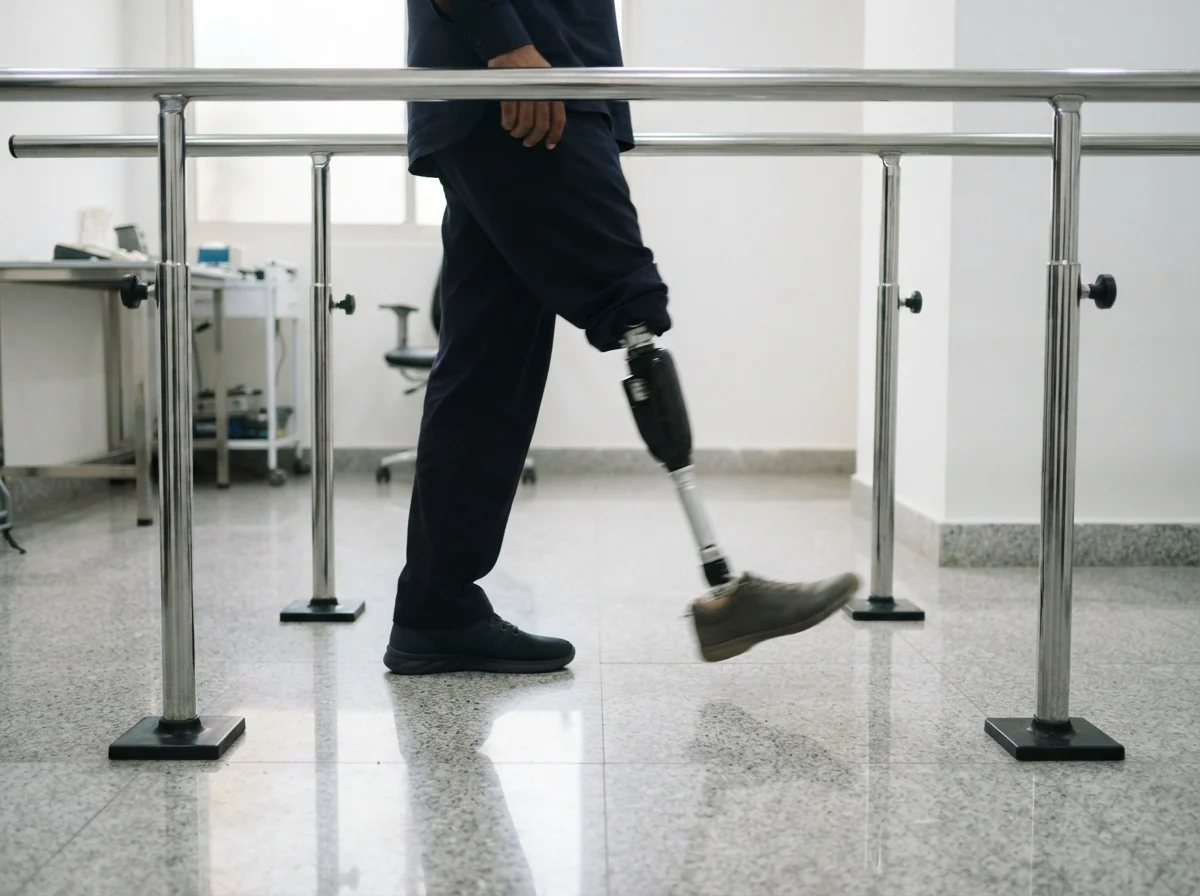
- Weight shifting and standing balance between the bars
- Stepping through with the sound leg first, then the artificial leg
- Sitting down and standing up without the knee folding early
- Stairs: good leg leads going up, artificial leg leads going down
- How to fall safely and how to get up from the floor
Training is part of the leg here. See how gait training runs.
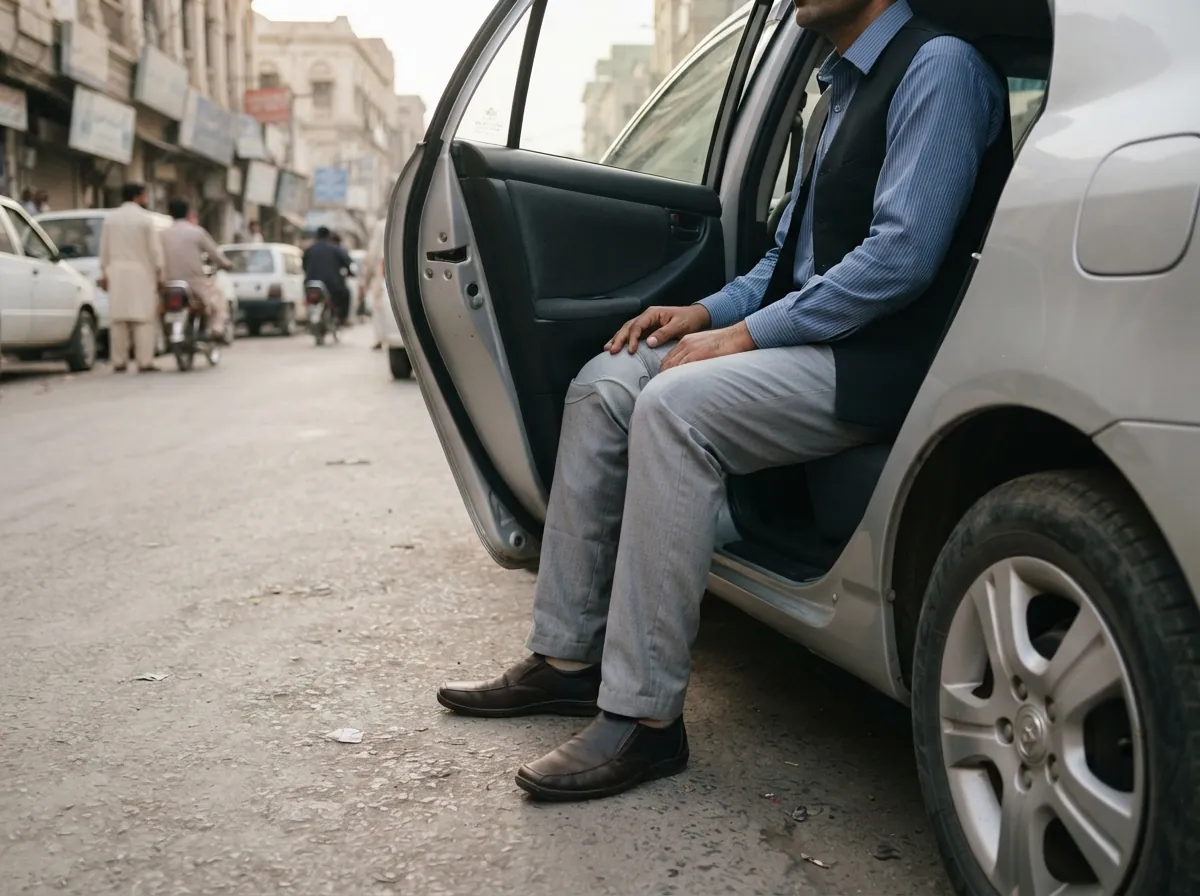
Sitting, cars, rickshaws and the floor
Most falls with an above knee leg do not happen while walking. They happen while turning, sitting down, or getting in and out of a vehicle. We practise these with you, because they are the movements you repeat all day.
Cars
Sit first, then bring the legs in. Going bottom first with the artificial leg trailing keeps the knee from folding under you. On the way out, place both feet on the ground before you stand.
Rickshaws and buses
The high step is the difficulty. Lead with the good leg going up, and hold the frame, not the driver seat. If the artificial side faces the door, turn and enter backward.
The floor
For meals and prayer on the floor, a rotation adapter above the knee lets the shin turn so you can sit cross legged. Without it, sit with the artificial leg out to the side. Getting up again is a skill we teach step by step.
The bathroom
Wet tiles and an artificial knee are a bad mix. A plastic stool in the shower and a grab bar near the commode cost little and prevent the worst injuries.
Above knee leg price in Karachi
Indicative ranges for 2026. The knee joint is the part that moves the figure most.
| Build | What it usually includes | Indicative range (PKR) |
|---|---|---|
| Affordable | Quadrilateral socket, belt suspension, manual lock or single axis knee, SACH foot | 150,000 to 280,000 |
| Mid range | Ischial containment socket, liner or suction, four bar knee, multi axis or basic carbon foot | 280,000 to 600,000 |
| High activity, imported | Imported hydraulic knee, carbon foot, custom liner | 600,000 to 1,500,000 |
| Microprocessor knee | Imported electronic knee with carbon foot | 1,500,000 to 2,500,000 and above |
A full breakdown is in the above knee price guide.
How long does an above knee leg take to make?
Usually three to four weeks from cast to delivery, with more fitting visits than a below knee leg because the socket brim and the knee alignment both need tuning. Training continues for several weeks after delivery.
How much harder is walking with an above knee leg?
Research commonly reports around 60 percent more energy than normal walking, and more for older or vascular patients. This is why heart and lung health matter, and why we do not rush older users onto a free swinging knee.
Is a German knee always better?
No. An imported hydraulic knee in a poor socket is worse than a simple four bar knee in a good socket. For an older person who walks inside the home and to the car, a safety knee or a locked knee is often the better and cheaper choice.
Can I sit on the floor with an above knee leg?
Sitting with the legs out in front or to the side is possible with most knees. Sitting cross legged is possible if a rotation adapter is added above the knee, which lets the shin turn sideways. Tell us if floor sitting is part of your daily life.
Will the leg fall off?
Not with proper suspension. A belt, a liner with a pin or strap, or suction holds the leg on. Suction gives the most secure feel but needs a stump that stays the same size through the day.
Can the knee be upgraded later?
Yes. Parts are modular. Many users start on a safer, cheaper knee, and move to a hydraulic knee after a year when their strength and confidence have grown. The socket and foot can stay.
Send a photo of the stump for a free opinion
Three clear photos on WhatsApp, front, side and end, with the date of surgery. The prosthetist replies with whether it is the right time, the kind of leg that suits, and a price range.
- Answered on WhatsApp, 24/7
- First assessment free, no obligation
- Nothing is stored on this website