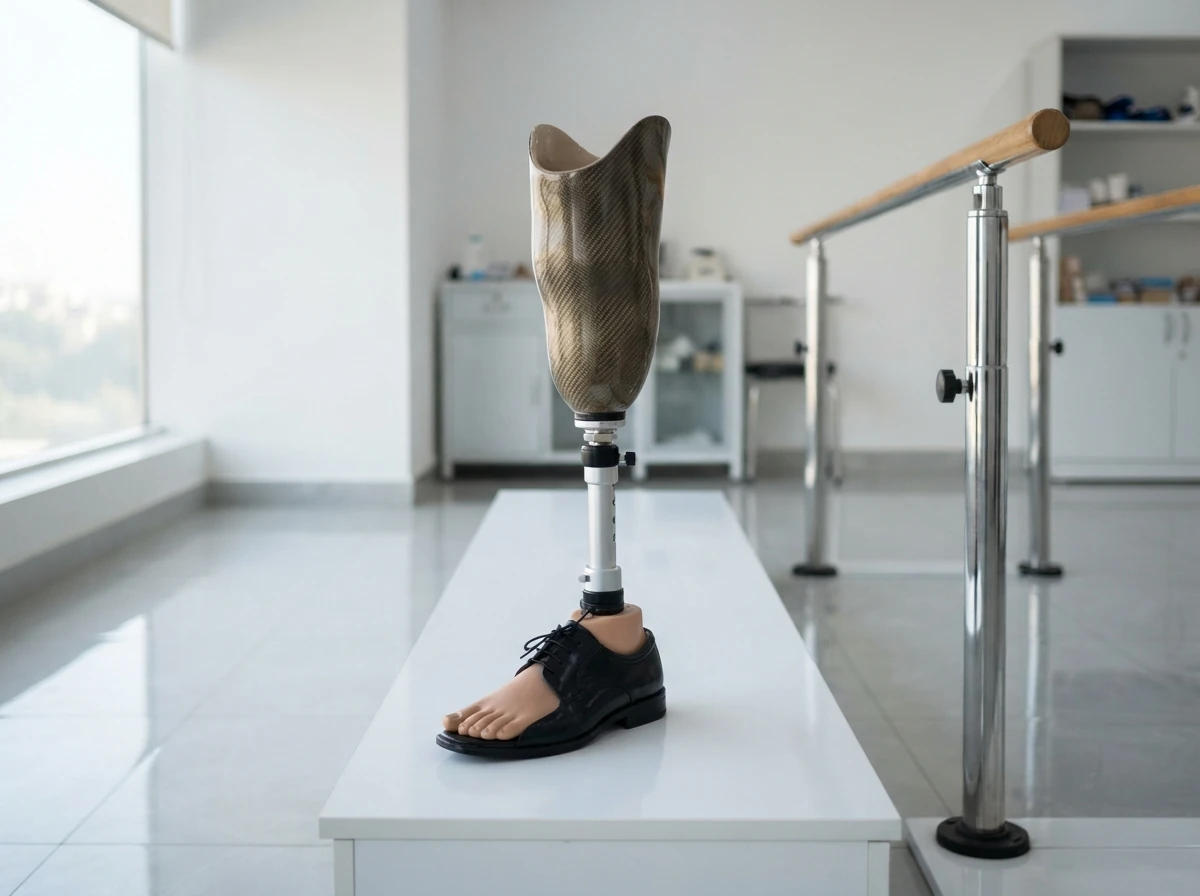
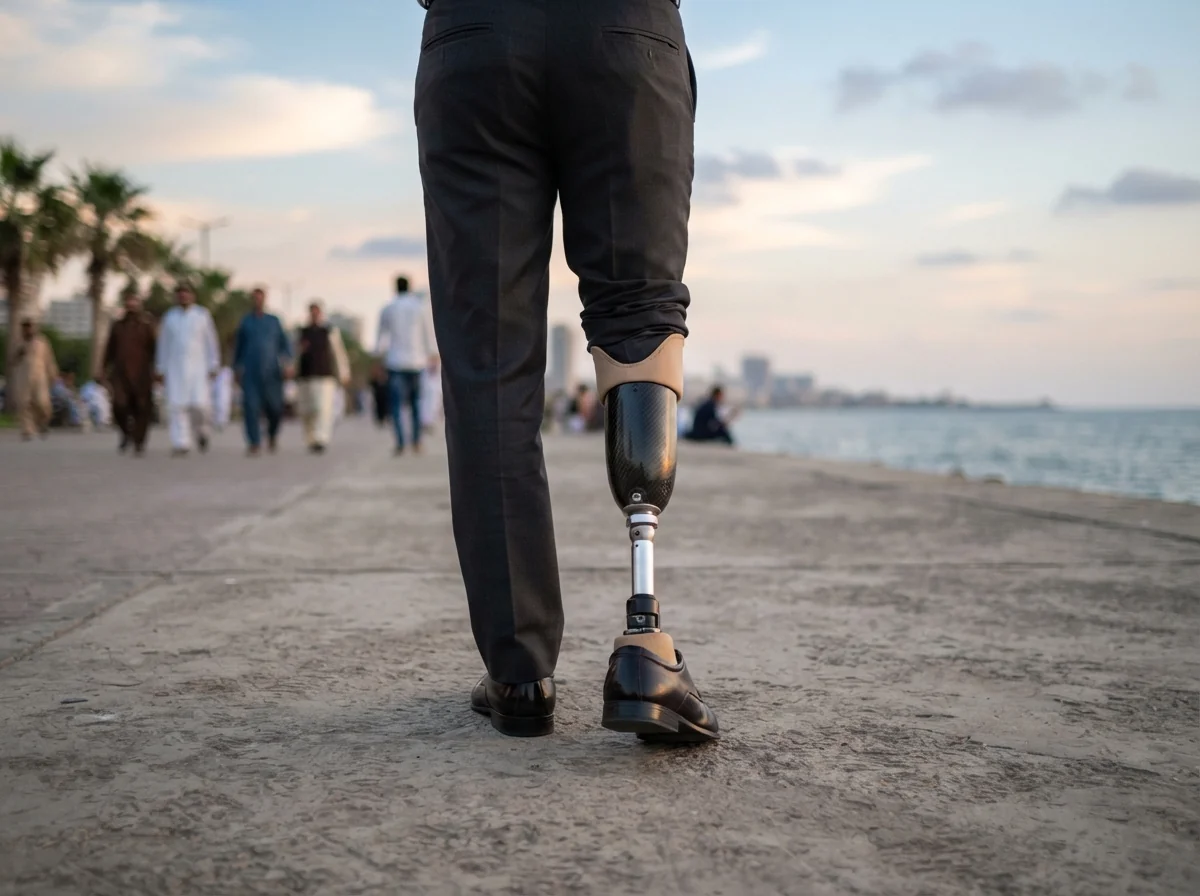
Artificial legs, made and fitted in Karachi
Custom below knee and above knee legs, built around a socket that fits and followed by gait training until you are steady on stairs and streets. The first assessment is free, and you get honest price ranges before you travel.
How do you get an artificial leg in Karachi?
You start with a free assessment, where a qualified prosthetist checks the stump, your strength and your daily routine. A plaster cast or scan is taken, a clear test socket is tried on, the leg is aligned while you walk between parallel bars, and gait training follows until you are steady on stairs and streets. A below knee leg takes two to three weeks. An above knee leg takes three to four.
Which artificial leg is made for which amputation
The level of the amputation decides the kind of leg. Pick yours to see how it is made, who it suits, and what it costs in Karachi.
Below knee leg
Your own knee still works, so walking comes back fastest. Most people are steady without a stick inside a few weeks.
Read the guideAbove knee leg
The leg carries a knee joint. The right knee for your age, strength and budget matters more than any brand name.
Read the guideKnee disarticulation leg
An amputation through the knee leaves a long, strong stump that can take weight on its end. The leg is built around that advantage.
Read the guideHip disarticulation leg
The hardest leg to make and to learn. We explain plainly what it can and cannot do before you spend anything.
Read the guideSymes and partial foot
When the heel or part of the foot is saved, a slim prosthesis restores length and push off inside a normal shoe.
Read the guideLegs for both sides
Two artificial legs need a different plan: shorter height at first, stable feet, and patient training.
Read the guideLegs for children
A child outgrows a leg the way they outgrow shoes. We plan for growth so you are not paying for a full new leg every year.
Read the guideNot sure of the level?
Send the discharge slip or a photo of the stump on WhatsApp. We will tell you the level and the kind of leg it needs.
How the free assessment worksAn artificial leg for every budget, from affordable to high end
Families often stay away because they fear the price. Please do not. We build good legs at three levels, and we would sooner fit a sound affordable leg than see someone go without.
Affordable
Below knee from about PKR 80,000. Above knee from about PKR 150,000. A properly made socket, tested adapters and a simple, durable foot and knee. A respectable leg that keeps a person walking and working.
See what it includesMid range
Below knee PKR 150,000 to 350,000. Above knee PKR 280,000 to 600,000. A cushioned liner with an easy lock, a foot for uneven ground, a four bar knee. What most adults choose.
See what changes the figurePremium imported
Below knee PKR 350,000 and above. Above knee PKR 600,000 to 2,500,000 and above. Carbon feet, hydraulic and microprocessor knees from the leading makers, imported to order.
See the brandsWhatever the budget, the first assessment is free, a test socket is tried before the final socket is made, and training is part of the leg. The lowest figure is the simplest sound build on a straightforward stump. A short, scarred or very heavy duty case costs more, and we tell you that on the phone, before you travel. Call us with the figure you have in mind, and we will tell you honestly what it can build.
One clinic, one prosthetist, from the cast to the last adjustment
An artificial leg is not a product taken off a shelf. It is a socket shaped to one person, joined to parts that are chosen for how that person lives. A retired teacher in Gulshan who walks to the masjid and back needs a different leg from a young man in Korangi who stands at a machine for ten hours.
At Artificial Leg Karachi the same prosthetist who examines you takes the cast, checks the test socket, sets the alignment and sees you at follow up. Nothing is handed over to someone who has never met you. When something rubs or feels wrong, the person who adjusts it already knows your stump.
- Free first assessment, with no obligation to order
- A clear test socket is tried before the final socket is made
- A written quotation that lists every part by name
- Gait training is part of the leg, not an extra
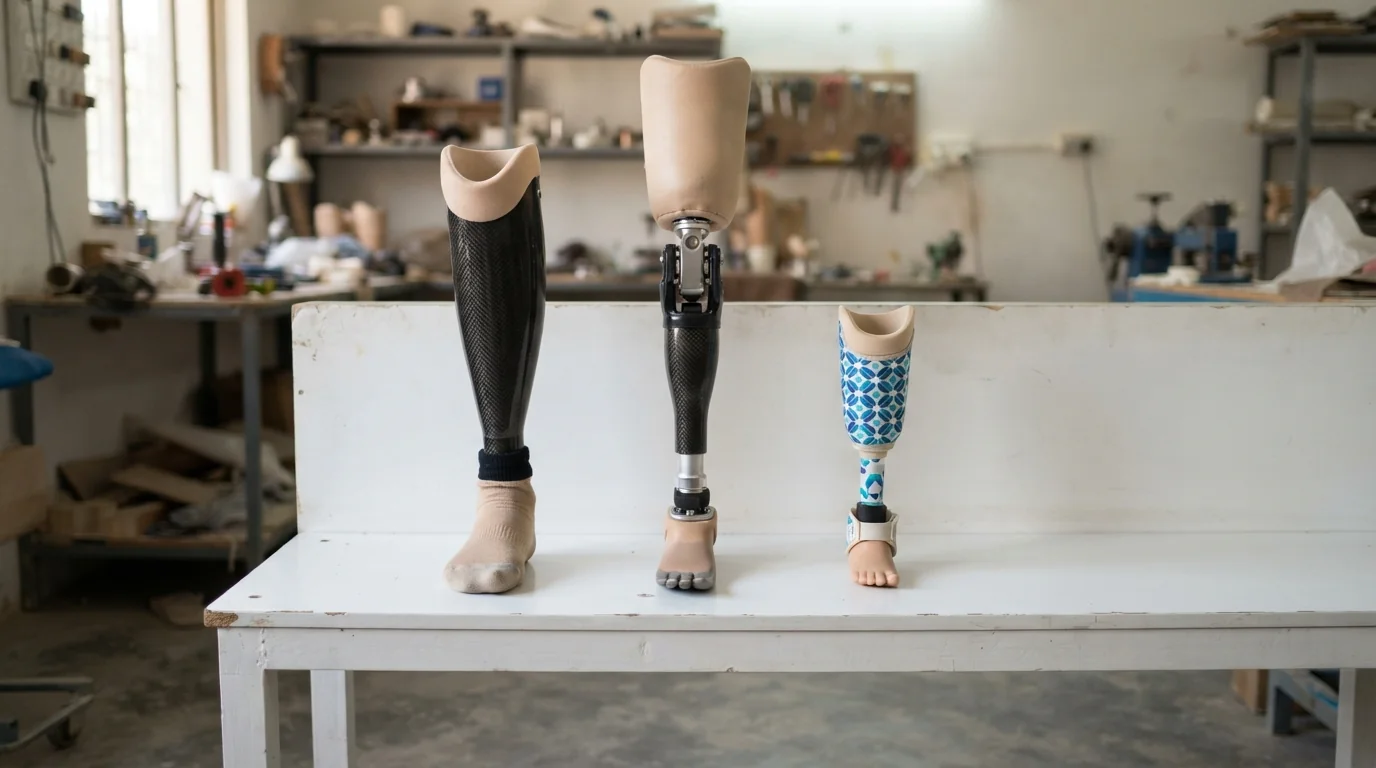
From first visit to walking: what happens and when
These are typical timings for a healed stump. Families coming from outside Karachi can have the visits grouped into one or two trips.
- Day 1
Free assessment
We check the stump, skin, muscle strength, the other leg and your balance, and ask about home, work and prayer. You leave knowing which leg is realistic and the price range.
- Day 1 or 2
Cast or scan
A plaster cast or a digital scan captures the exact shape of the stump. It takes under an hour and does not hurt.
- Week 1
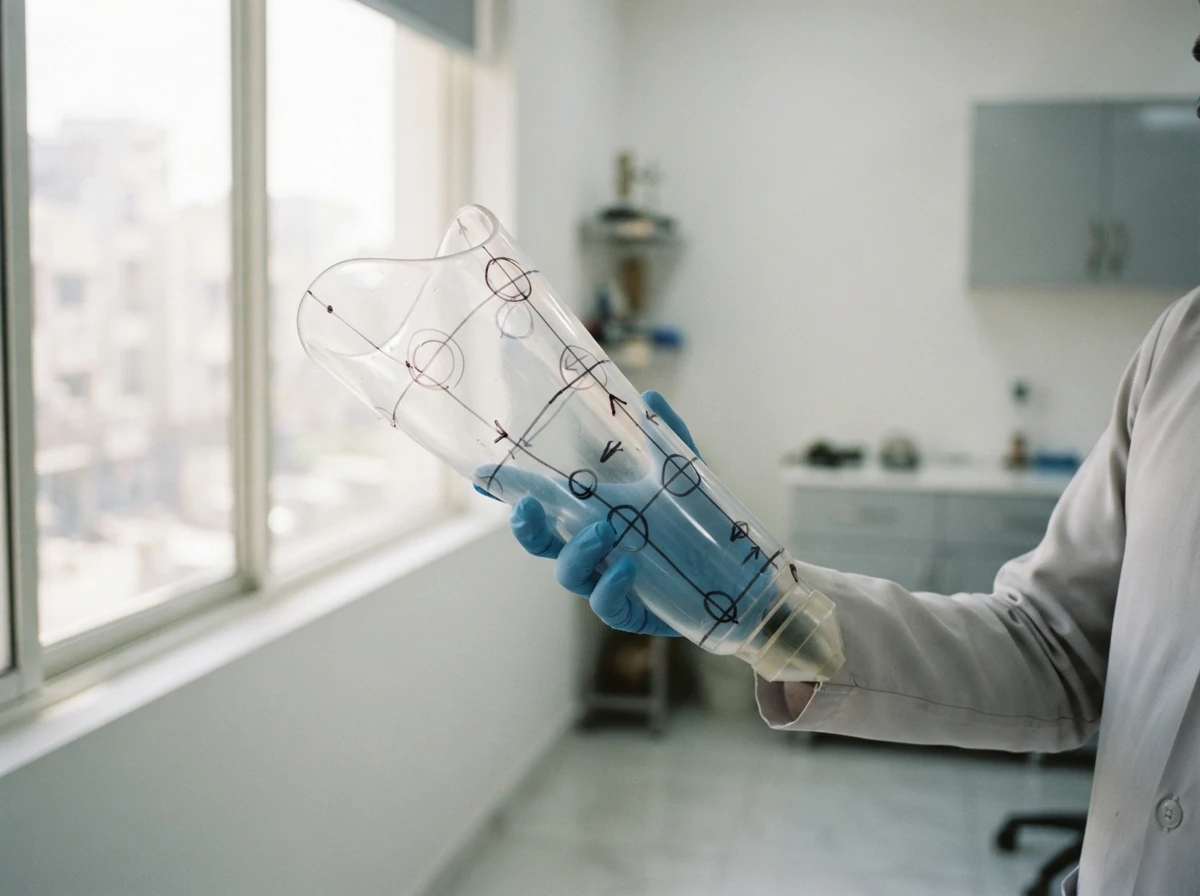
Test socket
A clear plastic socket lets us see where the skin is pressed and where there is a gap. We correct the shape before the final socket is built.
- Week 2
Alignment and first steps
The socket, pylon, foot and knee are joined. You walk between parallel bars while the angles are tuned to your stride.
- Week 2 to 4
Gait training
Standing, stepping, turning, stairs, ramps, getting up from the floor. You practise here first, then on real ground.
- Month 1 onward
Follow up
The stump shrinks in the first months. We add socks, pad or remake the socket so the fit stays safe.
The socket decides whether a leg is worn or left in a cupboard
People ask about German knees and carbon feet first. We understand why, because those are the parts with names and prices. But the part that touches your body is the socket, and a poor socket makes the most expensive knee useless.
If the socket is loose, the leg swings and you feel unsafe. If it is tight in the wrong place, the skin breaks and you stop wearing it. So most of our time goes into the cast, the test socket and the changes after it. If your budget is limited, we will tell you to spend it on the socket and the foot, and save on the rest.
- Spend first on the socket and liner
- Then on a foot that suits your ground and your shoes
- Then on the knee, if you need one
- Cosmetic covers come last
What an artificial leg costs in Karachi
Clinics that refuse to give any number make families travel across the city just to find out they cannot afford it. Here are honest ranges before you come.
| Type of leg | Locally made and mid range parts | Imported high activity parts |
|---|---|---|
| Below knee leg | 80,000 to 350,000 | 350,000 to 900,000 and above |
| Above knee leg | 150,000 to 600,000 | 600,000 to 2,500,000 and above |
| Knee disarticulation leg | 170,000 to 650,000 | 650,000 to 2,500,000 and above |
| Symes or partial foot prosthesis | 45,000 to 220,000 | 220,000 to 500,000 |
| Replacement socket only | 40,000 to 150,000 | 150,000 to 300,000 |
These are wide ranges on purpose, so you can plan. The firm figure comes in writing after the free assessment, with every part named. It does not change unless you agree to a change.
Below knee price guide Above knee price guide What decides the cost
Understand the parts before you compare quotations
Two quotations can differ by lakhs for the same amputation. These guides show you what you are being charged for.
Sockets and liners
Hard sockets, flexible inner sockets, silicone liners, pin locks and suction. What each feels like in Karachi heat.
Read the guideProsthetic feet
From the simple SACH foot to carbon energy return feet. Which one suits chappals, which one suits office shoes.
Read the guideKnee joints
Manual lock, single axis, polycentric, hydraulic and microprocessor knees, explained by who they keep safe.
Read the guideLocal vs imported parts
Where imported parts are worth the money and where a local part does the same job.
Read the guide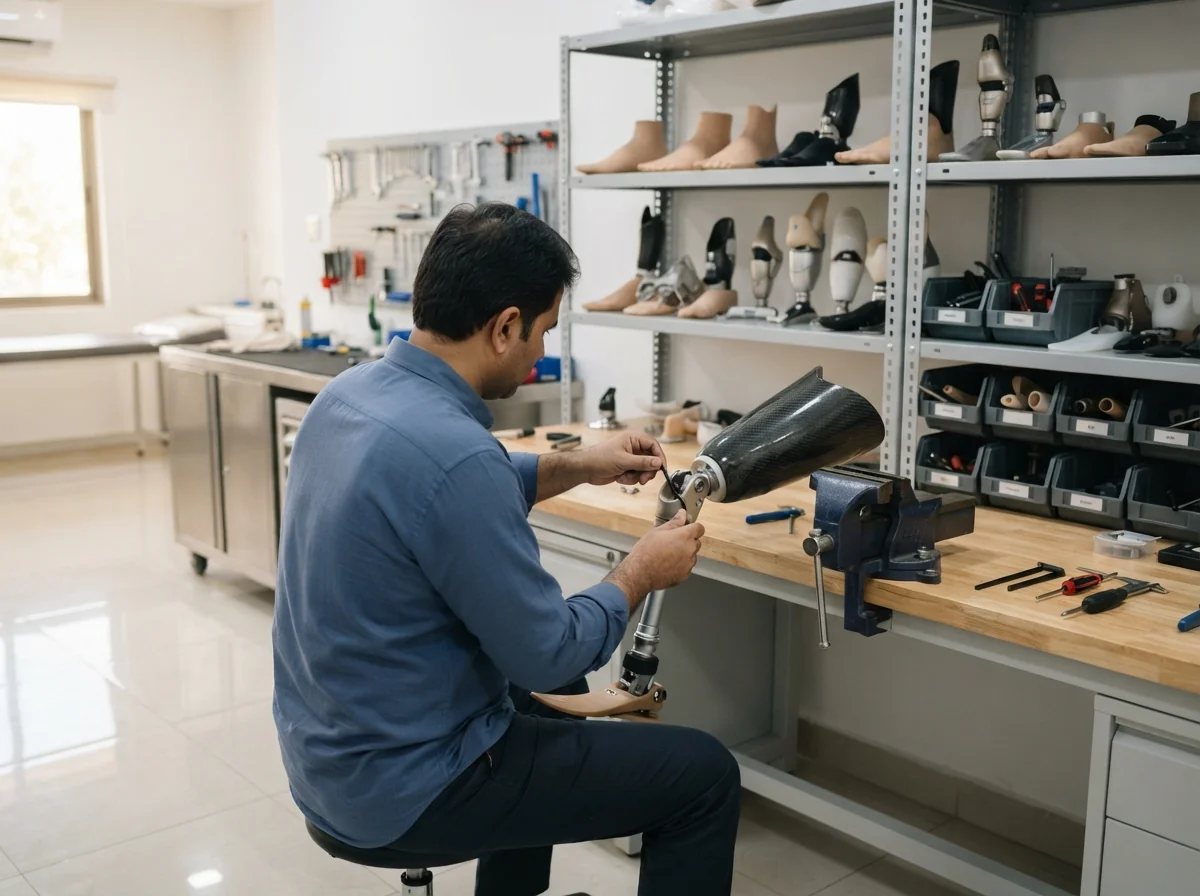
Ummad Shafique Mughal
Ummad Shafique Mughal is a consultant orthotist and prosthetist with more than seven years in clinical practice. He trained at the Pakistan Institute of Prosthetic and Orthotic Sciences (PIPOS) under Khyber Medical University, the national school for this profession, and earlier managed limb fitting work at CHAL Foundation.
- BS (Hons) Prosthetic and Orthotic Sciences, PIPOS, Khyber Medical University
- Former Manager and Ortho-Prosthetist, CHAL Foundation, Pakistan
- Sees patients at both the Gulshan-e-Iqbal and DHA clinics
Life with an artificial leg in Karachi
The leg is only useful if it fits into the day you actually live. These guides are written for this city, its weather and its streets.
Stump care
Washing, bandaging, shrinker socks and skin checks that keep you in the leg all day.
Read the guideStairs, slopes, rough ground
Broken footpaths, ramps without rails and bus steps. How to take each one safely.
Read the guideRiding a motorcycle
Which side, which level and which foot make riding realistic, and when it is not safe.
Read the guideNamaz with a leg
Standing, ruku, sajdah and sitting with a below knee or above knee leg, and when a chair is the right choice.
Read the guideReturning to work
Standing jobs, desk jobs, driving and shop work. What to ask your employer for in the first months.
Read the guideHeat, sweat and monsoon
Karachi humidity is hard on skin and liners. Daily habits that prevent rashes and smell.
Read the guidePatients from interior Sindh and Balochistan, and families abroad
A good share of the people we fit do not live in Karachi. They come from Hyderabad, Sukkur, Larkana, Quetta, Turbat and Gwadar, because there is no prosthetist near home. Others are in Karachi, while the son or brother who is arranging everything lives in Dubai, Riyadh, London or Houston.
For both, we start on WhatsApp, agree the plan and the price range before anyone travels, and group the clinic visits so the journey is made as few times as possible.
Six questions to ask any clinic, including ours
Families often pay an advance to the first place that gives a low number. Ask these first. A clinic that does honest work will answer all six without hesitation.
- Who will take the cast, and what is their qualification in prosthetics?
- Will a test socket be tried on before the final socket is made?
- Can I have the quotation in writing, with each part named?
- Is gait training included, and how many sessions?
- What happens when the stump shrinks in the first year, and what will a new socket cost?
- Who repairs the leg, and how quickly, if a part fails?
See your doctor before a fitting if
- the wound has not closed fully, or there is any discharge, redness or a bad smell
- the stump is painful at rest, very swollen, or has changed colour
- you are diabetic and your sugar has been out of control in recent weeks
- there is a new sore on your other foot
A leg fitted over an unhealthy stump causes harm. We will wait, and we will tell you so.
Artificial leg questions families ask us most
How much does an artificial leg cost in Karachi?
As an indicative range for Karachi in 2026, a below knee leg usually falls between PKR 80,000 and PKR 350,000, and an above knee leg between PKR 150,000 and PKR 600,000. Imported feet and hydraulic or microprocessor knees can take the figure well above that. The socket, the foot, the knee and the liner decide the number. You get a firm written figure after the free assessment, and it does not change unless you agree to a change.
How long does it take to get an artificial leg made?
Once the stump is healed and the swelling has settled, a below knee leg usually takes two to three weeks from the cast to walking out with the leg. An above knee leg usually takes three to four weeks because the socket and the knee need more fitting visits. Patients who travel in from another city can have the visits grouped together.
How soon after amputation can the first leg be fitted?
Most people are ready between six and twelve weeks after surgery, once the wound has closed fully and the stump has been shaped with bandaging or a shrinker sock. Diabetic and vascular patients often need longer. Your surgeon decides when the wound is ready, and we will ask for that clearance before we cast.
Do I need to visit the clinic, or can you start on WhatsApp?
You can start on WhatsApp from anywhere. Send the amputation level, the date of surgery and a clear photo of the stump, and the prosthetist will tell you honestly whether it is the right time, what type of leg is realistic and what price range to plan for. The cast and the fittings must be done in person at the Gulshan-e-Iqbal or DHA clinic.
My father is in Pakistan and I live abroad. Can I arrange his leg from here?
Yes. Many families do this. We speak with you on WhatsApp in your time zone, assess your father in Karachi, send you the written quotation, and share photos and short videos at the cast, the trial fitting and the first walk, so you can see what you are paying for at each step.
Will the leg need to be replaced?
The socket is the part that changes. In the first year the stump shrinks, so most new users need a replacement socket within six to eighteen months while the foot, the knee and the pylon carry on. After that, a well made leg that is serviced once a year commonly lasts three to five years before major parts need replacing.
Two clinics in Karachi: Gulshan-e-Iqbal and DHA
Calls and WhatsApp are answered 24/7. Tell us which clinic is closer and we will book you there.
Gulshan-e-Iqbal clinic
Main University Road, Block 13-C
Gulshan-e-Iqbal, Karachi
DHA clinic
Commercial Area, Phase 2 Extension
DHA, Karachi
Start with a free assessment
Tell us the amputation level and the city. We reply with honest guidance and a price range, on the phone or on WhatsApp, at any hour.
- Answered on WhatsApp, 24/7
- First assessment free, no obligation
- Nothing is stored on this website