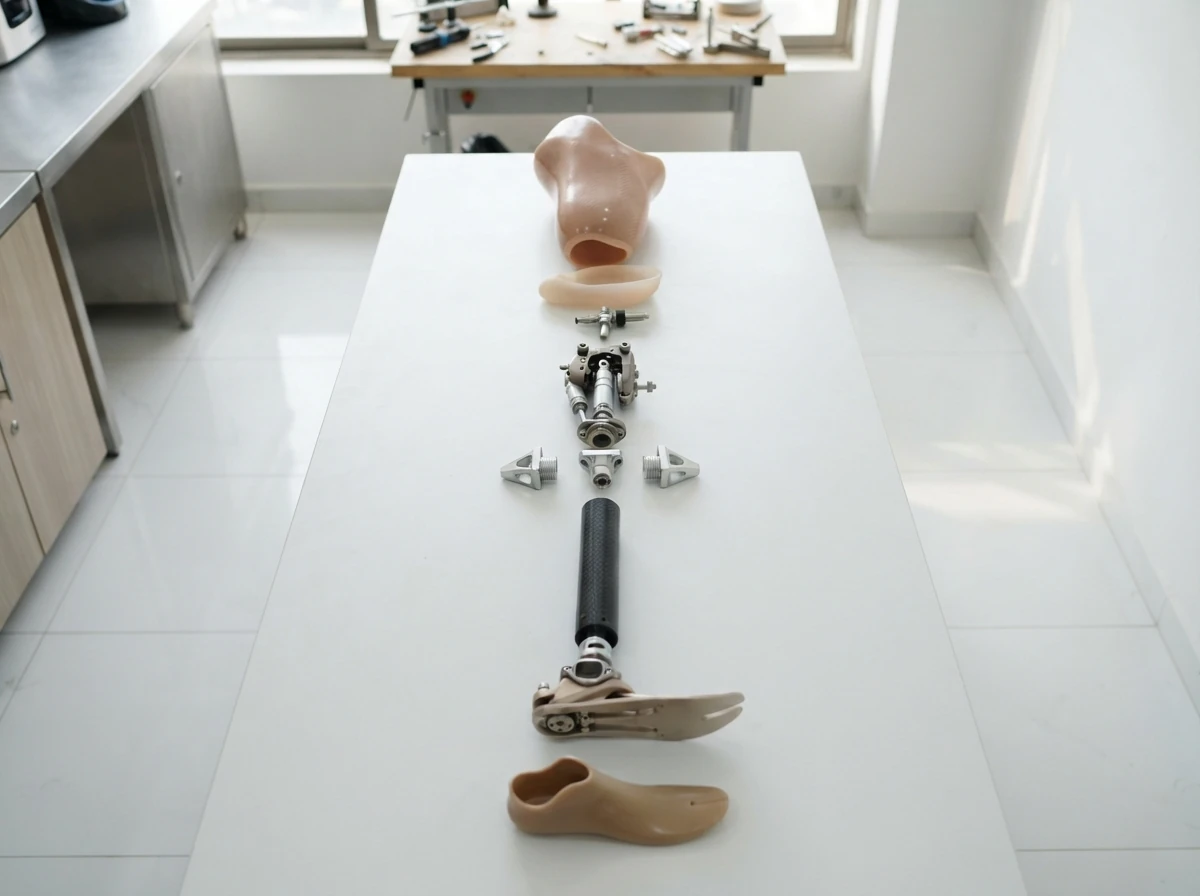
The parts of an artificial leg, explained
Two clinics can quote figures that differ by several lakh rupees for the same amputation. The difference is almost always in the parts. These guides explain each one in plain language, so you can read a quotation and ask the right questions.
What are the main parts of an artificial leg?
Every artificial leg has a socket that holds the stump, an interface such as a liner or sock between skin and socket, a suspension method that keeps the leg on, a pylon that replaces the bone, and a foot. Legs for amputations at or above the knee also have a knee joint. The socket is always custom made. The other parts are chosen from a range.
What each part does, and its share of the cost
| Part | Its job | Custom or bought in | Typical share of cost |
|---|---|---|---|
| Socket | Holds the stump, carries body weight, steers the leg | Always custom made by the prosthetist | 25 to 40 percent |
| Liner and suspension | Cushions the skin and keeps the leg on | Bought in, sized to you | 10 to 25 percent |
| Knee joint | Bends for sitting and walking, and must not bend when you stand on it | Bought in | Nil below the knee. 25 to 60 percent above it. |
| Foot | Absorbs the heel strike and gives push off | Bought in, matched to weight and activity | 10 to 30 percent |
| Pylon and adapters | Join everything and hold the alignment | Bought in | 5 to 10 percent |
| Cosmetic cover | Gives the leg a natural shape under clothes | Shaped by hand | 3 to 8 percent |
Shares vary widely with the knee and foot chosen. This is a general guide to help you read a quotation.
Read about each part
Sockets and liners
Materials, liner types, sock management, and the signs that a socket no longer fits.
Read the guideProsthetic feet
SACH, single axis, multi axis, carbon and hydraulic ankles, matched to ground, shoes and body weight.
Read the guideKnee joints
Stance control and swing control explained, then every knee type and who it keeps safe.
Read the guideLocal vs imported parts
Where imported parts earn their price, where a local part does the same job, and how to spot a used part sold as new.
Read the guideCosmetic covers
Foam, skin stockings, custom silicone and printed fairings, and what each costs you in function.
Read the guideIf the budget is limited, spend in this order
Families often arrive with a fixed sum and a brand name they have heard. Our advice is nearly always the same, and it rarely begins with the brand.
- First, the socket. Pay for the time and the test socket that make it fit. Nothing else works without it.
- Second, the liner. It is the only part that touches your skin all day.
- Third, the foot. It meets the ground several thousand times a day.
- Fourth, the knee. Choose the safest knee you can afford, not the fastest.
- Last, the cover. It can be added any time later.
Artificial Leg Karachi is not tied to any manufacturer. Brand names on this site are used only to describe products. We fit parts from several makers and recommend by need and budget, not by commission.
Which part of an artificial leg is most important?
The socket. It is the only part made for you alone, and it decides comfort, control and whether the leg is worn at all. A basic foot in a good socket beats a costly foot in a poor socket every time.
Can parts be upgraded later?
Yes. Modern legs are modular, joined by standard adapters. You can start with a basic foot or knee and change it in a year without remaking the socket.
Can parts from my old leg be reused?
Often the foot, knee and pylon can be reused if they are in good condition and rated for your weight. Bring the old leg to the assessment. The socket and liner are not reused.
How long do parts last?
As a guide with daily use in Karachi: liners six to twelve months, feet two to four years, mechanical knees three to five years with servicing, and sockets two to four years once the stump is stable.
Start with a free assessment
Tell us the amputation level and the city. We reply with honest guidance and a price range, on the phone or on WhatsApp, at any hour.
- Answered on WhatsApp, 24/7
- First assessment free, no obligation
- Nothing is stored on this website