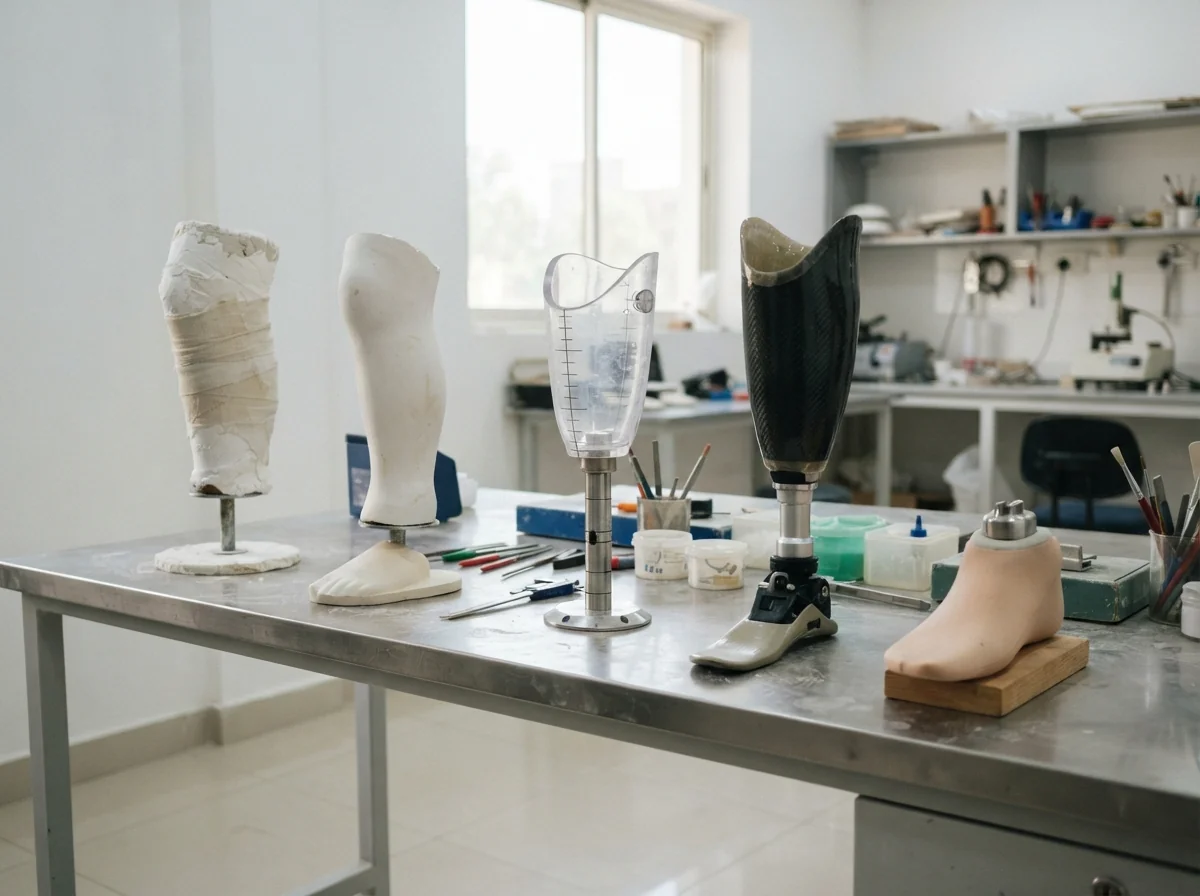
How an artificial leg is made, step by step
Most families come to us never having seen an artificial leg being made. Not knowing what happens next is a worry of its own. This section sets out each stage, how long it takes, and what is expected of you.
How is an artificial leg made?
First the prosthetist assesses the stump and your health. A plaster cast or scan captures the stump shape, and a model is made and refined from it. A clear test socket is tried on and corrected. The final socket is then built and joined to the knee, pylon and foot, aligned while you walk, and finished. Gait training and follow up visits complete the process.
How many visits, and how long each takes
| Visit | What happens | Time in clinic | Below knee | Above knee |
|---|---|---|---|---|
| 1 | Free assessment, and the cast if you are ready | 1 to 1.5 hours | Day 1 | Day 1 |
| 2 | Test socket fitting and corrections | 1 to 1.5 hours | Day 4 to 6 | Day 5 to 7 |
| 3 | Second test socket, if needed | 1 hour | Rarely | Often |
| 4 | Alignment and first walking between the bars | 1.5 to 2 hours | Day 10 to 14 | Day 14 to 20 |
| 5 | Delivery of the finished leg, and training begins | 1.5 hours | Day 14 to 21 | Day 21 to 28 |
| 6 onward | Training sessions and follow up | 45 minutes each | 6 to 10 sessions | 12 to 20 sessions |
Patients travelling from outside Karachi can have visits 1 to 5 grouped into five to seven working days. Tell us when you book.
Each stage in detail
First leg: the timeline
From the day of surgery to the end of the first year, week by week, including what to do while the wound heals.
Read the guideExercises before your leg
Stretches, strengthening and balance to do at home while the wound heals. Free, and worth more than any part.
Read the guideFree assessment
What we check, what to bring, what to send on WhatsApp first, and what you leave with.
Read the guideCasting and fitting
Cast or scan, the test socket, and the three stages of alignment, explained in plain words.
Read the guideGait training
From standing between the bars to stairs and streets, and the common walking faults we correct.
Read the guideRepair and maintenance
Daily and yearly checks, common faults, and what to do when something breaks.
Read the guideReplacement socket
When the stump has changed and the socket has not. Keeping your parts and renewing only the fit.
Read the guideWhat we need from you
A leg is made by two people: the one who builds it and the one who wears it. The best results come when the wearer does four things.
- Say what you feel. During fitting, tell us exactly where it presses, even if it seems small. We cannot feel it for you.
- Do the exercises. Ten minutes twice a day between visits is worth more than an expensive knee.
- Keep the appointments. A test socket is made for the stump as it is this week. Delay changes the stump.
- Bring someone. A family member who sees the training can help at home, and remembers what you forget.
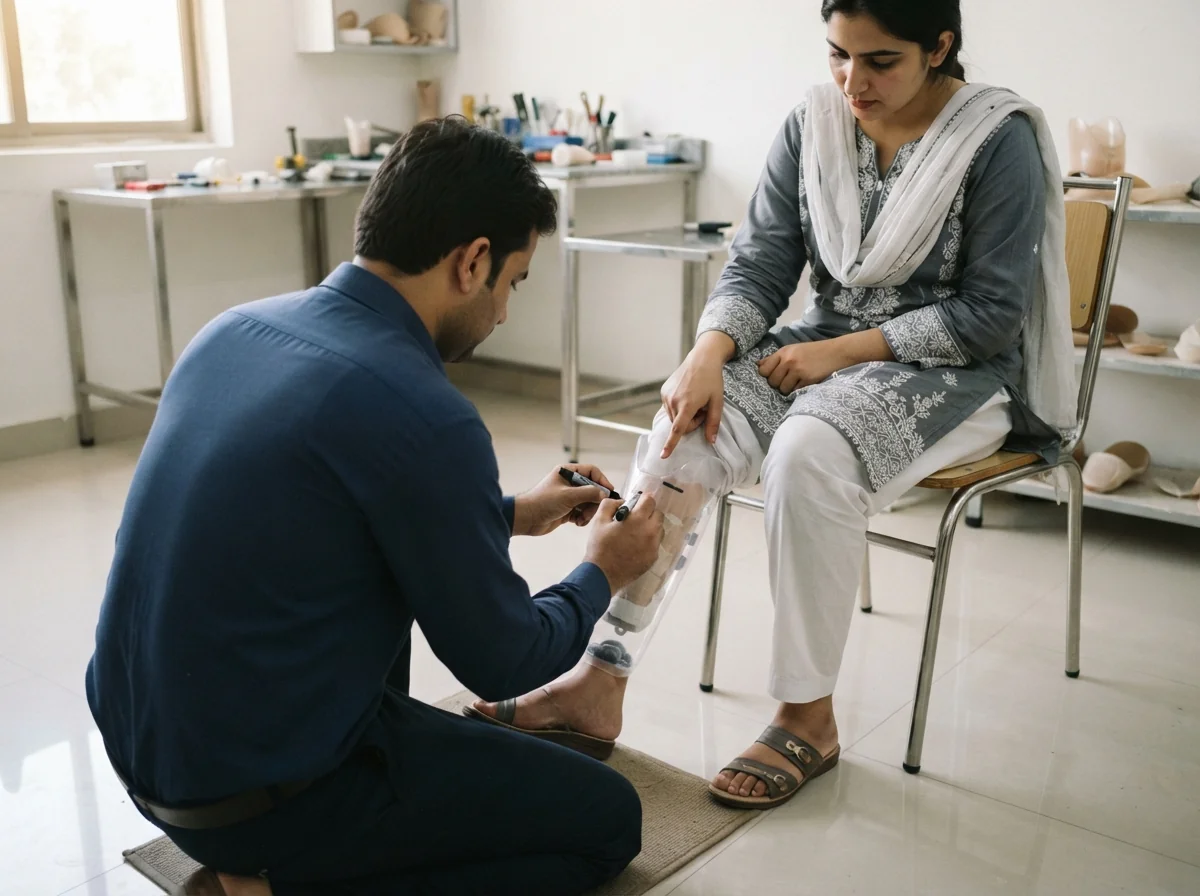
How long does the whole process take?
For a healed stump, two to three weeks for a below knee leg and three to four weeks for an above knee leg, followed by several weeks of training. Hip level legs and legs for both sides take longer.
Does any part of it hurt?
No stage should hurt. Casting feels warm and snug. A test socket may feel tight in places, and you tell us so that we can correct it. Muscles may ache after early training, as they would after any new exercise.
Can the visits be done in one week?
For below knee legs, usually yes, with one return visit a few weeks later. Tell us at booking that you are travelling, so workshop time is reserved for you.
Do I pay everything at the start?
No. You receive a written quotation after the assessment. An advance is taken when you confirm the order, and the balance is due at delivery. The assessment itself is free.
Start with a free assessment
Tell us the amputation level and the city. We reply with honest guidance and a price range, on the phone or on WhatsApp, at any hour.
- Answered on WhatsApp, 24/7
- First assessment free, no obligation
- Nothing is stored on this website