
The words on your discharge slip and quotation, in plain language.
Artificial leg glossary
Surgeons and prosthetists use a language of their own. If a word on a hospital paper or a quotation is unfamiliar, look here. If it is not here, ask us.
24/7Calls and WhatsApp answered
FreeFirst assessment
2Clinics in Karachi
7+ yrsProsthetist experience
Written and reviewed by Ummad Shafique Mughal, Consultant Orthotist and Prosthetist. Last reviewed September 2026.
Words families use
Urdu and everyday terms
- Masnoi taang
- The common Urdu term for an artificial leg. Also heard as masnui tang. In clinical language, a lower limb prosthesis.
- Naqli taang
- An informal Urdu term for an artificial leg, literally a false leg. It means the same device.
- Masnoi aaza
- Artificial limbs in general, both arms and legs.
- Stump
- The part of the limb that remains after amputation. Clinicians also say residual limb. We use stump on this site because it is the word families know.
- Artificial leg
- The everyday English term for a lower limb prosthesis. Prosthetic leg and artificial limb mean the same.
- Prosthetist
- The clinician who assesses, designs, fits and aligns artificial limbs. In Pakistan the degree is a BS in prosthetic and orthotic sciences.
On the discharge slip
Amputation levels
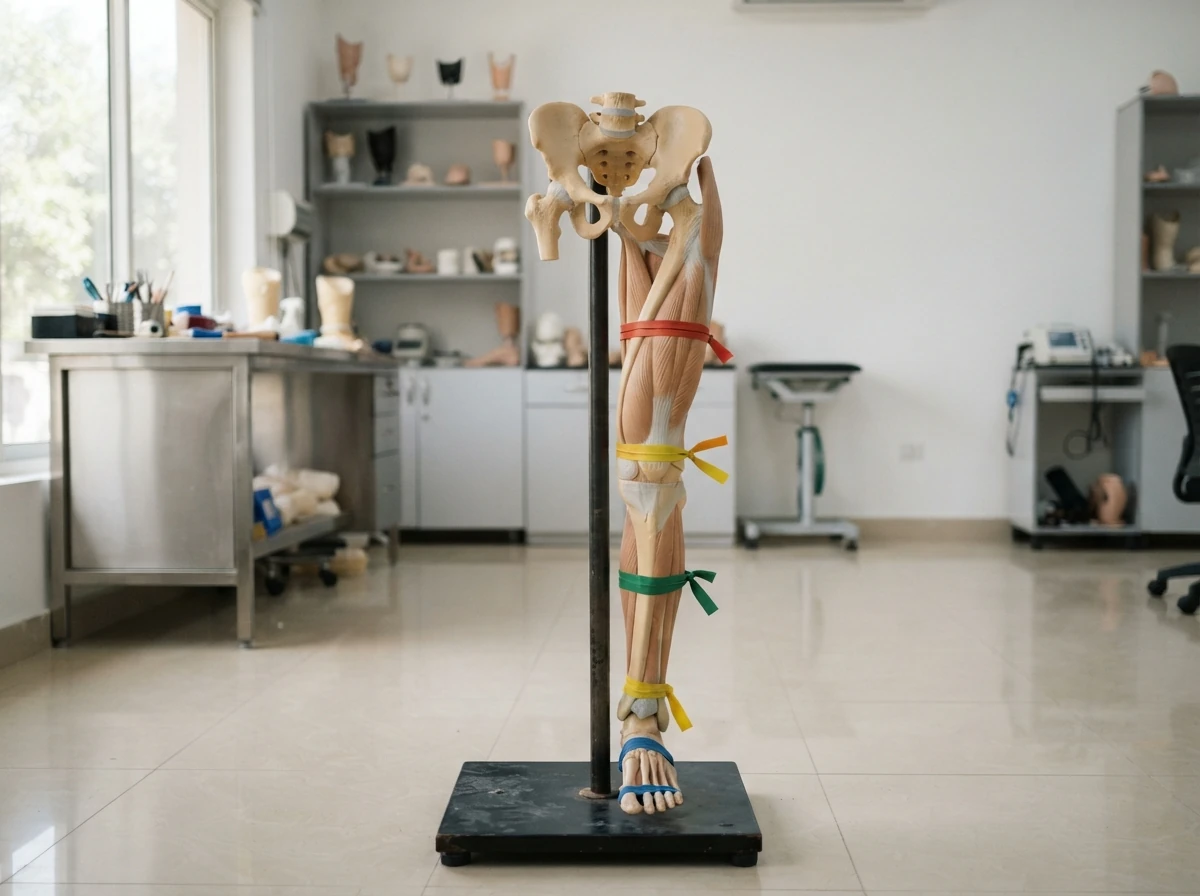
- Transtibial (BKA)
- Amputation through the shin, below the knee. Below knee leg.
- Transfemoral (AKA)
- Amputation through the thigh, above the knee. Above knee leg.
- Knee disarticulation
- Amputation through the knee joint, leaving the whole thigh bone. Through knee leg.
- Hip disarticulation
- Amputation through the hip joint. Hip level leg.
- Hemipelvectomy
- Removal of the leg together with part of the pelvis. Fitted in a similar way to hip disarticulation.
- Symes
- Amputation through the ankle, keeping the heel pad. Symes prosthesis.
- Transmetatarsal, Lisfranc, Chopart
- Partial foot amputations, from the front third of the foot to all but the heel.
- Bilateral
- Both sides. Legs for both sides.
- Revision
- A further operation on the stump, for example to smooth a bone end or improve the soft tissue cover.
On the quotation
Parts of the leg
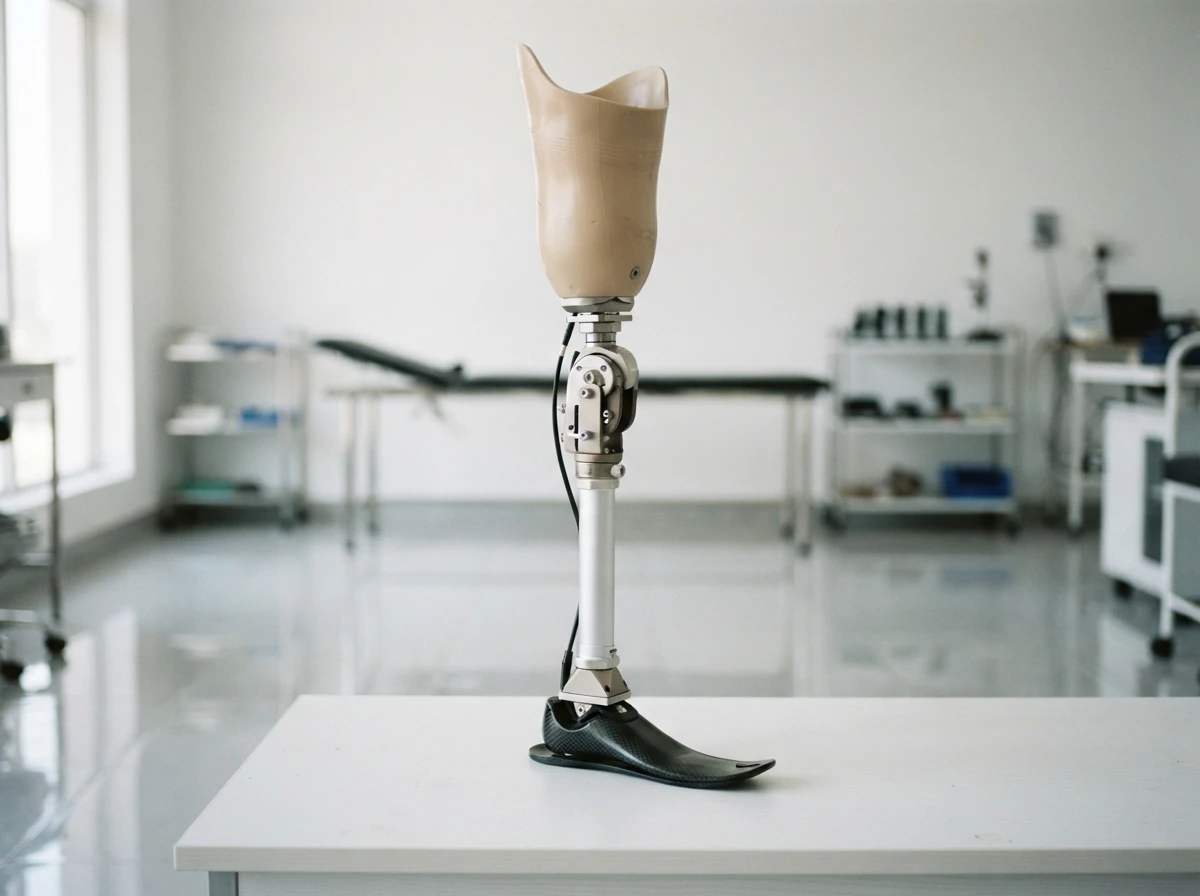
- Socket
- The custom made shell the stump sits in. Sockets and liners.
- Test socket (check socket)
- A clear plastic trial socket used to see and correct pressure before the final socket is made.
- Liner
- A soft silicone or gel sleeve rolled onto the stump to cushion the skin and often to hold the leg on.
- Stump sock and ply
- A cotton or wool sock worn in the socket. Ply is its thickness, in one, three or five. Socks are added as the stump shrinks.
- Shrinker
- An elastic sock worn when the leg is off, to control swelling and shape the stump.
- Suspension
- Whatever holds the leg on: strap, sleeve, pin lock, lanyard, suction or vacuum.
- Pin lock (shuttle lock)
- A pin on the end of the liner that clicks into a lock in the bottom of the socket.
- Suction and vacuum
- Suspension by removing air between the stump and socket through a one way valve, or with a small pump.
- PTB and TSB
- Two below knee socket designs. Patellar tendon bearing loads the tendon below the kneecap. Total surface bearing spreads load over the whole stump.
- Quadrilateral and ischial containment
- Two above knee socket shapes. The second cups the sitting bone for better control.
- Pylon
- The tube that replaces the shin bone and joins the socket or knee to the foot.
- Pyramid adapter
- The small four screw connector that joins parts and allows the alignment to be adjusted.
- SACH foot
- Solid ankle cushion heel. The simplest prosthetic foot. Prosthetic feet.
- Multi axis foot
- A foot that moves up and down and tilts side to side, for uneven ground.
- Energy return foot
- A carbon fibre foot that stores energy as it bends and releases it at push off.
- Polycentric (four bar) knee
- A knee with a linkage that is stable at heel strike and folds compactly. Knee joints.
- Hydraulic knee
- A knee whose fluid cylinder matches swing speed to walking pace and yields slowly under load.
- Microprocessor knee (MPK)
- A knee with sensors and a small computer that adjusts resistance continuously and resists a stumble.
- Rotation adapter (turntable)
- A unit above the knee that lets the shin turn sideways for floor sitting and getting into a car.
- Cosmesis
- The shaped foam cover and stocking that give the leg a natural outline.
- Modular (endoskeletal)
- A leg built from a central tube and interchangeable parts, which can be upgraded or realigned.
In the fitting room
Process and walking terms
- Casting
- Capturing the shape of the stump in plaster or with a scanner. Casting and fitting.
- Rectification
- Reshaping the plaster or digital model to load tolerant areas and relieve sensitive ones.
- Lamination
- Building the final socket from layers of fibre soaked in resin over the model.
- Alignment
- The exact position and angle of socket, knee and foot relative to each other. Done on the bench, standing, then walking.
- Donning and doffing
- Putting the leg on, and taking it off.
- Gait
- The manner of walking. Gait training teaches it on a prosthesis.
- Gait deviation
- A fault in walking, such as leaning, vaulting or swinging the leg outward. It has a cause in the leg, the body or habit.
- Stance and swing
- The part of a step when the foot is on the ground bearing weight, and the part when it is moving through the air.
- Pistoning
- Up and down movement of the stump inside the socket, a sign of poor suspension or a loose fit.
- End bearing
- Taking weight through the end of the stump, possible at Symes and through knee levels.
- Contracture
- A joint that has stiffened in a bent position from shortened muscles. It must be stretched before a leg can be aligned.
- Volume
- The size of the stump, which changes through the day and over months.
- Activity level
- A description of how much and how variably a person walks, from indoor transfers to sport. Parts are chosen to match it.
Sensation and skin
Terms for what you may feel or see
- Phantom sensation
- Feeling the missing limb. Nearly universal and usually harmless.
- Phantom pain
- Painful sensations felt in the missing limb. Treatable. Tell your doctor.
- Neuroma
- A tender lump where a cut nerve has healed. The socket is relieved over it. Persistent cases need a doctor.
- Desensitisation
- Daily massage, tapping and rubbing that teach a tender stump to accept touch and pressure.
- Bony overgrowth
- In children, bone at the stump end growing faster than the skin over it. A matter for the surgeon.
- Folliculitis
- Infected hair roots on the stump, seen as pimples. Worse with sweat and shaving.
- Verrucous hyperplasia
- Dark, thick, warty skin at the stump end, caused by the end not being in contact with the socket. Corrected by changing the socket.
Start with a free assessment
Tell us the amputation level and the city. We reply with honest guidance and a price range, on the phone or on WhatsApp, at any hour.
- Answered on WhatsApp, 24/7
- First assessment free, no obligation
- Nothing is stored on this website