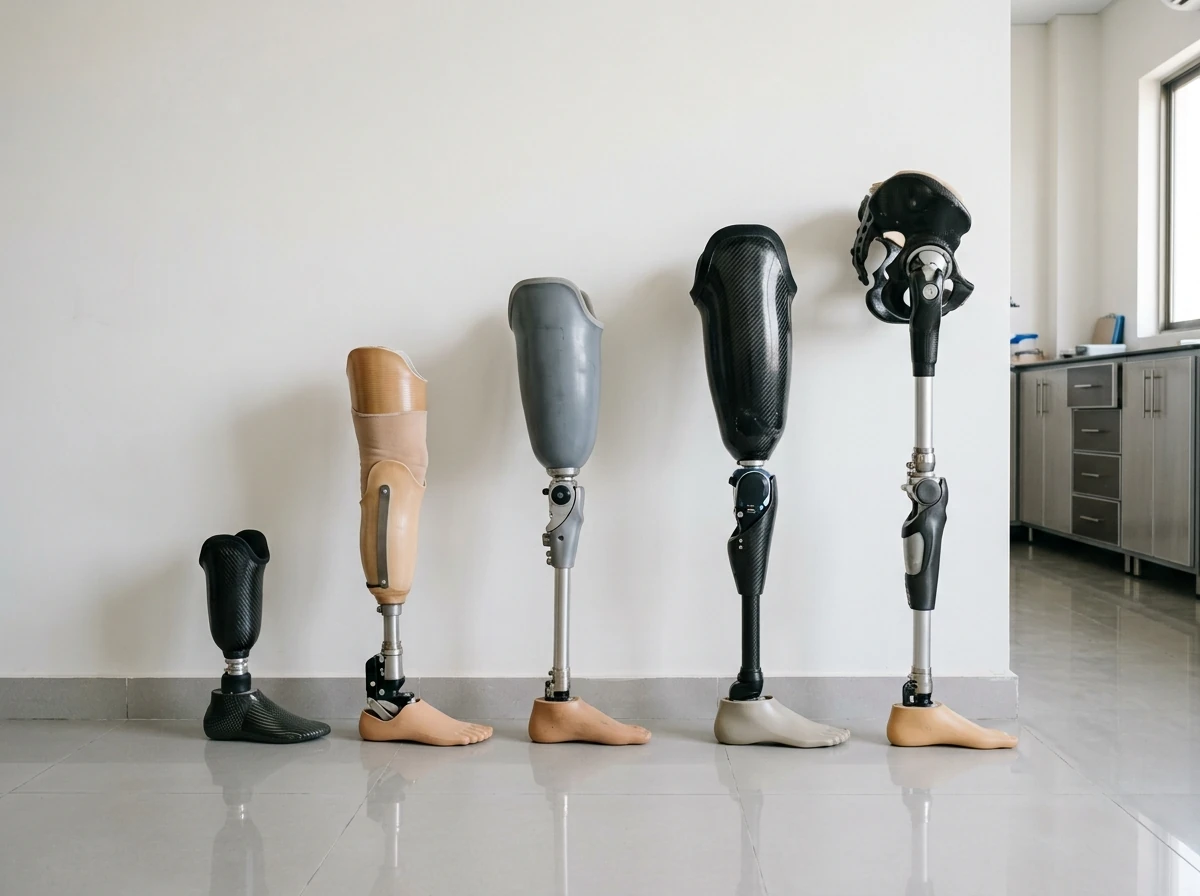
Artificial leg types, explained by amputation level
The level of the amputation decides the kind of leg, how hard it is to learn, and what it costs. Find your level below, then read the full guide for it.
Which activity level are you?
Makers of prosthetic parts rate every knee and foot for an activity level from 1 to 4. Knowing yours is the quickest way to the right kind of leg, and the right budget.
Level 1: indoors
Transfers and slow walking on level floors, with a frame or stick. Goal: stand and move safely at home. Light leg, locking or safety knee, simple stable foot. The affordable tier usually fits.
Legs for elderly patientsLevel 2: limited outdoors
Walks slowly outdoors, manages kerbs, a step or two and uneven ground, for limited distances. Safety knee or four bar knee, multi axis foot. Affordable to mid range.
Below knee legLevel 3: community walker
Walks at changing speeds, handles most obstacles, works, shops and travels. Four bar or hydraulic knee, multi axis or carbon foot, gel liner. Mid range, sometimes premium.
Above knee legLevel 4: high activity
Runs, plays sport, stands or carries loads all day, or is a very active child. Hydraulic or microprocessor knee, carbon foot, suction or vacuum. Premium imported parts earn their price here.
Sports legsThe level is judged by the prosthetist from your strength, balance, health and daily life, not chosen from a list. Most people move up a level in the first year, which is one reason we suggest starting with a safe, sensible build. Check whether the stump is ready, then come for the free assessment.
Which artificial leg do I need?
It depends on where the leg was amputated. If your own knee was saved, you need a below knee leg, which is the easiest to walk on. If the amputation is through or above the knee, the leg must include a knee joint. At the hip, the leg hangs from a socket around the pelvis. The discharge slip from your surgeon states the level.
From the foot upward: what is left, and what is made
The more of your own leg that was saved, the less work the artificial leg has to do and the less energy walking takes.
| Level | Surgeon may write | What the leg must replace | Learning effort |
|---|---|---|---|
| Partial foot | Transmetatarsal, Chopart, Lisfranc | Front of the foot and push off | Low |
| Symes | Ankle disarticulation | Foot and ankle. The heel pad is kept. | Low |
| Below knee | Transtibial, BKA | Shin, ankle and foot | Moderate |
| Through knee | Knee disarticulation | Knee joint, shin, ankle and foot | Moderate to high |
| Above knee | Transfemoral, AKA | Part of the thigh, knee, shin, ankle and foot | High |
| Hip | Hip disarticulation, hemipelvectomy | Hip joint, thigh, knee, shin, ankle and foot | Very high |
Learning effort is a general guide. Age, strength, the other leg and the reason for amputation change it for each person.
Choose your level
Below knee artificial leg
The most common level in Karachi. Your own knee does the work, so results are the best of any level.
Read the guideAbove knee artificial leg
The leg includes a knee joint. Safety when the knee bends is the main design question.
Read the guideKnee disarticulation leg
A long stump that can carry weight on its end. Needs a special compact knee.
Read the guideHip disarticulation leg
A socket around the pelvis with three joints below it. Honest expectations matter most here.
Read the guideSymes and partial foot
A slim prosthesis or filler that restores length and push off inside a normal shoe.
Read the guideLegs for both sides
Two artificial legs need a staged plan, starting short and stable.
Read the guideLegs for children
Built to be lengthened as the child grows, with sockets planned for regular change.
Read the guideLegs for elderly patients
Light, safe and simple. Transfers first, distance second, and an honest word on when a wheelchair is kinder.
Read the guideLegs for women
Privacy in the fitting room, a natural outline under shalwar, heel heights, pregnancy and weight changes.
Read the guideWaterproof and shower legs
Why the everyday leg must stay dry, and the four ways to deal with water.
Read the guideRunning blades and sports
Most sport needs a good everyday leg. When a blade makes sense, and what it costs.
Read the guideThe reason for the amputation changes the plan
Two people with the same below knee amputation may need quite different care. A young man who lost his leg in a road accident usually has healthy skin, strong muscles and a good other leg. An older person who lost the leg to diabetes may have thin skin, poor feeling, weaker circulation and a second foot that is also at risk.
So we ask why the leg was amputated before we talk about parts. It changes the liner we choose, how tight the socket can be, how often we want to see the skin, and how fast training should go.
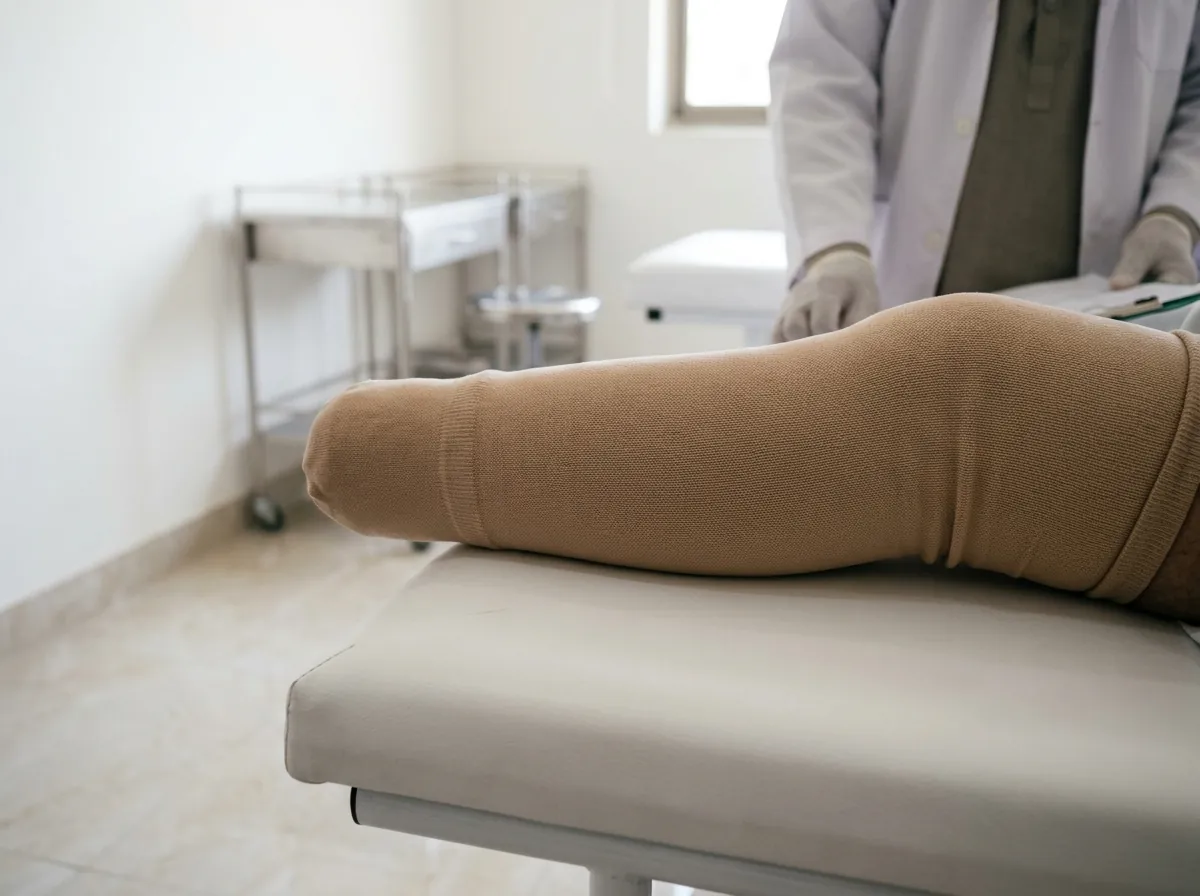
How do I know my amputation level?
Look at the hospital discharge slip. It will say transtibial or BKA for below knee, transfemoral or AKA for above knee, or name a disarticulation. If you do not have the slip, send a photo of the stump on WhatsApp and the prosthetist will tell you the level.
Which level is easiest to walk on?
Below knee, by a clear margin. Your own knee controls the leg, so walking takes only a little more energy than before. Above knee walking takes far more effort, and hip level walking more again.
Can one clinic make every type of leg?
Yes, all seven levels are made and fitted at our Karachi clinics by the same prosthetist. Hip level legs and legs for both sides take longer, and we say so at the start.
Is an artificial leg always the right answer?
No. For some people, such as a frail person with a hip level amputation or very poor heart health, a wheelchair or crutches give more freedom with less risk. We will say this plainly at the free assessment if it applies to you.
Start with a free assessment
Tell us the amputation level and the city. We reply with honest guidance and a price range, on the phone or on WhatsApp, at any hour.
- Answered on WhatsApp, 24/7
- First assessment free, no obligation
- Nothing is stored on this website